Big Letter Tracing for Toddlers: Building Early Writing Confidence
Developing fine motor skills is one of the most significant milestones in early childhood education, yet it often presents unique challenges for both children and their caregivers. BIG Letter Tracing for Toddlers serves as a foundational bridge between unstructured play and formal handwriting instruction. Unlike standard worksheets designed for older children, resources specifically tailored for toddlers utilize large-scale formatting to accommodate developing muscle control and visual tracking abilities. This approach recognizes that early learners require exaggerated visual targets to successfully connect hand movements with letter formation.
For parents, homeschoolers, and early childhood educators, finding age-appropriate tracing materials can be frustrating. Standard workbooks often feature letters that are too small for a toddler’s grasp, leading to frustration rather than engagement. By utilizing BIG Letter Tracing for Preschoolers and Toddlers, adults can provide a developmentally appropriate scaffold that builds confidence before precision. The oversized format allows children to use gross motor movements initially, gradually refining their control as they gain proficiency. This resource is designed to meet learners exactly where they are, transforming the daunting task of alphabet acquisition into an accessible and enjoyable daily activity.
Addressing Common Early Literacy Challenges
Many adults seek out tracing resources because they observe specific hurdles in their child’s development. Understanding these challenges helps in selecting the right tools and setting realistic expectations. BIG Letter Tracing for Toddlers directly addresses several key developmental bottlenecks:
- Limited Fine Motor Control: Toddlers typically use a palmar grasp rather than a pincer grasp. Large letters allow for success with immature grip patterns, preventing the bad habits that form when children are forced to write too small too soon.
- Visual Processing Overload: Small, densely packed worksheets can overwhelm young visual systems. A spacious 8.5×11 inch trim size with high-resolution interiors ensures that each letter stands out clearly against a clean background, reducing cognitive load.
- Short Attention Spans: Engagement is fleeting at this age. Big, bold lines are inherently more inviting and satisfying to trace than tiny dotted lines, helping to extend focus periods naturally through positive sensory feedback.
- Frustration Tolerance: When tasks are too difficult, toddlers disengage. Oversized tracing provides immediate "wins," fostering a growth mindset and associating writing practice with feelings of competence rather than failure.
How Oversized Tracing Supports Developmental Goals
The primary goal of introducing BIG Letter Tracing for Toddlers is not perfect penmanship, but rather the establishment of neural pathways connecting vision and movement. Large-format tracing supports proprioception—the body’s ability to sense movement and position. When a child traces a six-inch tall letter 'A', their shoulder, elbow, and wrist must coordinate in a way that reinforces spatial awareness. This proximal-to-distal development pattern is essential; stability in the shoulder girdle eventually translates to dexterity in the fingers.
Furthermore, this method supports letter recognition through kinesthetic learning. Research suggests that multi-sensory experiences deepen memory retention. As the child physically moves through the shape of a large letter, they are encoding its structure more effectively than through visual observation alone. For preschoolers transitioning toward kindergarten readiness, BIG Letter Tracing for Preschoolers and Toddlers acts as a critical review tool, solidifying uppercase and lowercase associations before introducing smaller line spacing and more complex stroke sequences.
Practical Applications and Implementation Strategies
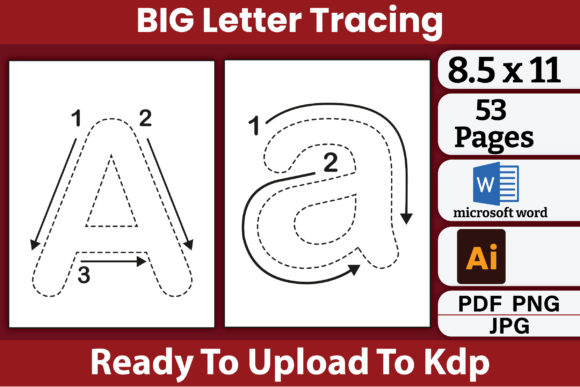
Having access to a comprehensive 53-page resource is only the first step; how you implement it determines its effectiveness. Because this download includes versatile formats like PDF, PNG, JPEG, Ai, and Microsoft Word files, users have exceptional flexibility in adapting the content to their specific environment.
Diverse Usage Scenarios
Home Learning Environment: Parents can print pages from the high-resolution PDF onto standard 8.5×11 inch paper. Since there is no bleed, printing on home printers is straightforward without losing content to margins. For repeated practice without wasting paper, place printed sheets inside clear plastic sheet protectors and use dry-erase markers. This turns a single page of BIG Letter Tracing for Toddlers into an indefinite reusable activity station.
Classroom and Therapy Settings: Occupational therapists and special education teachers may utilize the editable Microsoft Word or Adobe Illustrator (Ai) files to customize the experience. If a student responds better to specific colors, fonts, or thematic icons, the source files allow for modification. The PNG and JPEG options are ideal for digital integration, allowing educators to project letters onto interactive whiteboards for group gross-motor tracing activities where children use their entire arm to trace in the air or on a vertical surface.
Sensory Integration: Beyond pencil and paper, big letters serve as templates for tactile exploration. Print the pages and have children trace over them using playdough, wiki sticks, or textured fabrics. The large scale makes these sensory adaptations feasible, whereas standard-sized letters would be too intricate for such materials.
Tailoring the Approach to Different Users
While the core content remains consistent, different stakeholders will leverage BIG Letter Tracing for Preschoolers and Toddlers in distinct ways based on their objectives.
Parents of Neurodivergent Children: For children with dyspraxia or autism spectrum disorder, standard worksheets can be visually chaotic. The clean, high-contrast design of big letter tracing reduces sensory defensiveness. Parents might focus on one letter per session, using the editable files to isolate specific shapes that align with the child’s current interests or therapeutic goals.
Homeschool Curriculum Planners: Those designing a structured literacy block can integrate these 53 pages as a dedicated "handwriting warm-up" module. Because the files are digital, they can be reorganized within the Word document to match the sequence of phonics instruction, ensuring that tracing practice reinforces current reading lessons rather than occurring in isolation.
Daycare Providers: In group settings, durability and cost-efficiency are paramount. Providers can laminate select pages from the collection to create permanent writing center materials. The variety of pages ensures that the center remains fresh and engaging over months of use, accommodating mixed-age groups where toddlers and preschoolers work side-by-side at different skill levels.
Maximizing Value Through File Versatility
The inclusion of multiple file types is a significant advantage for practical application. Understanding when to use each format enhances the utility of BIG Letter Tracing for Toddlers:
- PDF File: Best for direct printing. Ensures formatting consistency across devices and preserves the intended 8.5×11 inch no-bleed layout.
- Microsoft Word: Ideal for customization. Add names, change instructions, or adjust sizing for specific accessibility needs.
- Ai File: Professional-grade vector editing. Allows for infinite scaling without pixelation, useful for creating posters or floor-sized tracing mats.
- PNG/JPEG Files: Perfect for digital display, tablet apps, or incorporating individual letters into other educational projects and presentations.
Ultimately, successful early writing instruction relies on meeting the child’s physical and cognitive needs with patience and appropriate tools. BIG Letter Tracing for Toddlers removes the barrier of premature precision, replacing anxiety with accomplishment. Whether used as a standalone curriculum supplement, a therapeutic intervention tool, or a fun rainy-day activity, this resource provides the necessary foundation for lifelong literacy. By prioritizing scale, clarity, and adaptability, caregivers can ensure that every child has the opportunity to experience the joy of making their mark, quite literally, one big letter at a time.