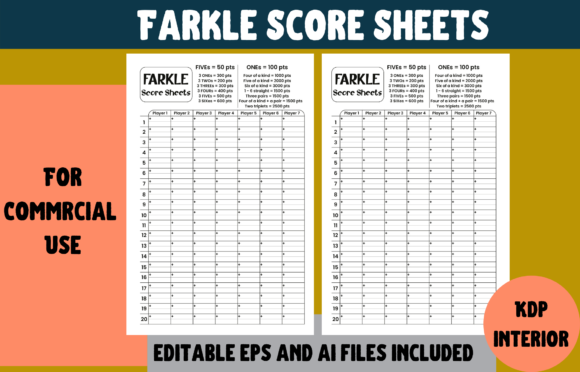
Farkle Score Sheets KDP Interior: Selecting the Right Layout for Game Night Success
Creating or purchasing a high-quality scorekeeping tool for Farkle requires more than just finding a grid with empty boxes. For self-publishers, game designers, and enthusiastic players looking to print their own materials, the Farkle Score Sheets KDP Interior represents a specific intersection of utility and design. This resource is not merely a collection of blank pages; it is a structured system designed to accommodate the unique scoring mechanics of Farkle while adhering to the technical constraints of Amazon’s print-on-demand platform. Understanding the nuances of this specific interior template can prevent costly printing errors and ensure that the final product actually enhances the gaming experience rather than hindering it.
Many creators and consumers overlook the critical relationship between game mechanics and page layout. Farkle is distinct from Yahtzee or other dice games because of its cumulative scoring within a turn and the risk-reward nature of "farkling." A generic score sheet often fails to provide adequate space for tracking running totals across multiple rolls in a single turn. When evaluating a 120-page, 6x9 inch portable interior, you must verify that the column width allows for legible handwriting during fast-paced play. If the cells are too narrow, players will write over lines, leading to confusion and disputes. The ideal interior balances compact portability with functional whitespace, ensuring that seven players can track twenty rounds without feeling cramped.
Technical Specifications and File Format Pitfalls
One of the most frequent mistakes when acquiring digital assets for KDP is assuming that a PDF file is universally ready for upload. While this pack includes a PDF file ready for upload or print, relying solely on this format limits your ability to correct issues or customize the product for niche audiences. The inclusion of EPS and AI files is a significant advantage that many users ignore until they encounter a problem. Vector-based source files allow you to adjust line weights, modify font sizes, or alter the header design without losing resolution. Rasterizing these files prematurely or failing to check them in Adobe Illustrator before converting to PDF can result in blurry text or pixelated lines that look unprofessional in print.
Furthermore, the "no bleed" specification is a technical detail that demands strict attention. In a 6x9 inch book with no bleed, all content must remain within a defined safe zone. A common error occurs when designers or users assume the printable area extends to the very edge of the paper. On KDP, margins are non-negotiable. If the score table extends too close to the gutter (the inner binding edge), players will struggle to write in the leftmost columns once the book is bound. Before finalizing any project using this interior, measure the margin safety specifically for a 120-page count. Thicker books require wider gutters than thinner ones, and a template designed for a 50-page booklet may fail when applied to a 120-page volume.
Evaluating Player Capacity and Round Structure
The specification of supporting seven players for twenty rounds is generous, but it introduces layout challenges that must be verified. A practical warning for buyers and creators is to test the actual usability of a seven-player spread on a 6x9 page. Seven columns plus a label column consume significant horizontal space. If the font size used for player names is too large, the scoring columns become unusably narrow. Conversely, if the font is too small, older players or those playing in dim lighting may find the sheet frustrating. Always print a physical test copy at actual size before committing to a bulk order or publishing. Digital previews on screens are deceptive regarding tactile usability.
Additionally, consider the flow of twenty rounds. Does the interior include a dedicated area for bonus scoring or end-game calculations? Farkle rules vary significantly between households and official tournaments. Some versions award bonuses for three pairs or four-of-a-kind, while others do not. A rigid template that lacks a flexible "notes" or "bonus" section forces players to scribble in margins, defeating the purpose of a professional score sheet. When reviewing the Farkle Score Sheets KDP Interior, look for adaptable spaces that respect the variability of house rules. If the template is too prescriptive, use the provided AI files to add a small legend or bonus tracker at the bottom of each page.
Avoiding Design and Usability Oversights
Aesthetics should never compromise function in game accessories. A prevalent misunderstanding is that darker backgrounds or heavy graphical elements make a score sheet look more premium. In reality, high-ink coverage on standard KDP paper can lead to bleed-through, especially when players press hard with pens or pencils. Since this is a double-sided 120-page book, what happens on page 4 affects page 5. Stick to clean, high-contrast black-and-white designs. Ensure that table lines are thin enough to save ink but visible enough to guide the eye. Heavy grid lines compete with handwritten numbers, making scores difficult to read at a glance.
Another oversight involves the placement of the score guideline. Beginners and professionals alike benefit from having the scoring combinations visible on the score sheet itself. However, placing this reference material in the center of the scoring grid creates visual clutter. A better approach is to utilize the header or footer space, or to dedicate the first few pages of the 120-page book entirely to rules and scoring charts. This keeps the active scoring pages clean while still providing necessary support. If you are modifying the EPS or AI files, consider creating a tear-out reference card or a dedicated instruction section that does not interfere with the primary data entry areas.
Strategic Checks Before Publishing or Printing
Before uploading your finalized PDF to KDP or sending it to a local printer, conduct a comprehensive pre-flight check. Verify that the document dimensions are exactly 6x9 inches, not 6.125 x 9.25 inches or any other variation. Even a fraction of an inch discrepancy will trigger automatic rejection or unwanted scaling. Confirm that all fonts are embedded or outlined in the PDF to prevent substitution errors. Test the grayscale output specifically; colors that look distinct on a monitor may render as identical shades of gray in print, rendering color-coded sections useless.
- Margin Verification: Measure the inner margin on a printed proof to ensure writing comfort for seven players.
- Paper Opacity Test: Check if pen marks show through to the reverse side of the 120-page block.
- Rule Compatibility: Ensure the scoring columns align with the specific Farkle variant your audience plays.
- File Integrity: Open the source AI/EPS files to confirm layers are intact and editable.
- Binding Safe Zone: Validate that no critical scoring areas fall within the gutter bind zone.
Ultimately, the value of this interior pack lies in its flexibility and adherence to production standards. By treating the Farkle Score Sheets KDP Interior as a foundational template rather than a finished product, you avoid the pitfalls of generic design. Whether you are a marketer creating branded merchandise, an educator teaching probability, or a hobbyist organizing a tournament, taking the time to validate these technical and practical details ensures a superior result. The goal is a score sheet that disappears into the background of the game, allowing players to focus entirely on the strategy and social interaction that make Farkle enduringly popular. Diligence in the preparation phase translates directly to satisfaction during gameplay.