Evaluating the New Year Journal KDP Interior for Professional Publishing
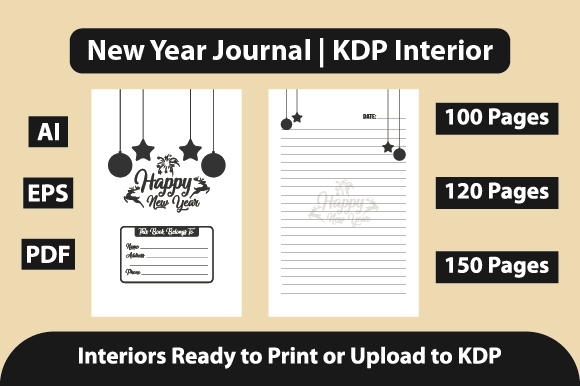
The low-content publishing market on Amazon has matured significantly, shifting away from generic templates toward specialized, high-value assets. For publishers targeting the Q4 and Q1 seasonality, a dedicated New Year Journal KDP Interior represents a strategic product rather than a simple notebook. This asset is designed specifically for the 6" x 9" trim size, the industry standard for personal planning and reflection journals. Available in 100, 120, and 150-page configurations, these interiors address specific consumer needs regarding goal setting, habit tracking, and annual review without requiring the publisher to design complex layouts from scratch.
What distinguishes a professional-grade interior from a basic template is the inclusion of editable source files alongside the print-ready PDF. While the high-quality PDF ensures immediate upload capability for Amazon KDP, the provision of AI and EPS files offers long-term utility. This dual-format approach allows serious publishers to customize branding, adjust prompts, or create derivative products, transforming a single purchase into a flexible foundation for an entire catalog line.
Technical Specifications and Print Readiness
For any KDP project, technical compliance is non-negotiable. A New Year Journal KDP Interior must adhere strictly to Amazon’s printing specifications to avoid rejection or poor customer reviews. The 6" x 9" format utilized here is optimal for this niche; it provides sufficient writing space while remaining portable enough for daily carry. Larger formats often feel cumbersome for journaling, while smaller sizes limit the utility of structured prompts.
The availability of three distinct page counts—100, 120, and 150 pages—reflects an understanding of different user behaviors and price points. A 100-page journal typically serves as a quarterly tracker or a minimalist annual overview, appealing to users who prefer brevity. The 120-page option strikes a balance, offering ample room for weekly reflections without excessive bulk. The 150-page variant caters to intensive planners and those integrating extensive habit tracking or gratitude logs. From a publishing perspective, having these options pre-formatted eliminates the guesswork regarding spine width calculations and margin safety zones.
Crucially, these interiors are configured with proper bleed settings. Bleed is essential when design elements extend to the edge of the page, preventing unsightly white borders after trimming. Many amateur designers fail at this stage, resulting in rejected manuscripts. A verified print-ready PDF with correct bleed margins ensures that the final physical product looks professionally manufactured. When evaluating this asset, verify that the safe zone margins account for the specific page count selected, as gutter requirements shift slightly between 100 and 150 pages.
File Flexibility: PDF vs. Editable Source Files
The true value proposition for entrepreneurs and marketers lies in the file ecosystem. Relying solely on a static PDF limits a business to a single SKU. If market trends shift or if you wish to test different cover designs paired with unique internal branding, a locked PDF becomes a bottleneck. The inclusion of AI (Adobe Illustrator) and EPS files addresses this limitation directly.
- Brand Consistency: Publishers managing multiple imprints can modify headers, footers, and intro pages to match their specific brand identity across various journal titles.
- Niche Adaptation: An educator might adapt the general New Year Journal KDP Interior for academic goal setting, while a fitness coach could swap generic prompts for health-specific metrics using the vector files.
- Error Correction: Even high-quality assets may require tweaks based on beta reader feedback. Editable files allow for rapid iteration without redesigning the entire layout.
- Bundling Opportunities: Vector elements can be extracted to create matching bookmarks, social media graphics, or digital companion products.
This flexibility transforms the interior from a consumable good into a capital asset. For freelancers and agencies creating journals for clients, the editable files reduce turnaround time significantly, allowing for customization that justifies premium pricing.
Design Quality and User Experience
Aesthetic appeal drives conversion, but usability drives retention and positive reviews. In the context of a New Year Journal, "unique design" must mean functional clarity rather than decorative excess. Users engaging in annual planning need visual hierarchy that guides them through introspection without overwhelming them. Effective interiors utilize whitespace strategically, ensuring that writing areas are inviting rather than cramped.
When assessing the design quality of this interior, consider the line weight and contrast. Lines that are too dark can appear harsh in print and distract from handwritten content, while lines that are too light may disappear on standard KDP cream paper. Professional interiors typically use a grey-scale stroke (often 20-30% black) for writing guides to maintain a soft, premium feel. Additionally, the typography used in prompts and section headers should be legible and neutral, avoiding overly stylized fonts that might clash with the user's handwriting or date the product quickly.
The structure of the content within the New Year Journal KDP Interior also warrants scrutiny. Does it include forward-looking sections like vision boarding or SMART goal breakdowns? Does it offer retrospective prompts for reviewing the previous year? A well-balanced interior combines both, facilitating a complete transition cycle. Publishers should review the sample pages to ensure the prompts are open-ended enough to appeal to a broad demographic but specific enough to provide genuine value over blank lined paper.
Market Viability and Audience Fit
Not every publisher needs this specific asset. It is best suited for creators who view low-content books as part of a broader content strategy rather than a quick cash grab. Professionals, coaches, and niche site owners will find the highest ROI because they can leverage the editable files to align the journal with their existing audience. For example, a financial blogger can customize the budget tracking sections, making the journal a relevant merchandising opportunity rather than a generic add-on.
Conversely, hobbyists looking for a one-off upload may find the editable features unnecessary, though the print-ready PDF still offers a time-saving advantage. However, even casual publishers benefit from the professional formatting. Amazon’s algorithm increasingly favors books with higher engagement and better reviews; a polished, error-free interior contributes directly to these metrics. The 6" x 9" size and varied page counts also allow for A/B testing different price points and perceived values within the same niche.
Educators and corporate trainers represent another key demographic. The start of the year is a natural anchor for professional development and student success programs. Having a customizable interior allows these professionals to distribute branded journals as part of workshops or courses, adding tangible value to their services. The ability to edit the AI/EPS files means they can remove irrelevant sections or add organization-specific logos, creating a bespoke resource at a fraction of custom design costs.
Practical Considerations and Limitations
While the New Year Journal KDP Interior offers significant advantages, realistic expectations are necessary. First, software compatibility matters. To utilize the AI and EPS files effectively, you need access to Adobe Illustrator or compatible vector editing software like Affinity Designer. Users without these tools are limited to the PDF version, which reduces the long-term versatility of the purchase.
Secondly, uniqueness requires effort. Because this is a commercially available asset, other publishers may use the same base interior. To compete effectively, customization is not optional—it is mandatory. Simply uploading the stock PDF puts you in direct competition with everyone else who bought the same file. Successful publishers use the source files to alter at least 20-30% of the content or layout, ensuring their product stands out in search results and delivers distinct value to customers.
Finally, consider the seasonal nature of this product. New Year journals have a sharp demand curve, peaking in December and January. Publishers should plan their launch schedules accordingly, aiming to have listings live and indexed by early November. Using a pre-made interior accelerates this timeline, allowing more focus on keyword research, cover design, and marketing campaigns during the critical sales window. After the season passes, the editable files remain valuable for repurposing into undated goal journals or quarterly planners, extending the asset's lifecycle beyond the holiday rush.
Ultimately, the decision to acquire this New Year Journal KDP Interior should be based on workflow efficiency and scalability. It solves the technical hurdles of bleed, margins, and pagination while providing a professional aesthetic baseline. For those willing to invest time in customization using the provided vector files, it serves as a robust engine for building a sustainable publishing portfolio. You can get your copy of the New Year Journal Interior Design now to streamline your production process and enter the upcoming season with a polished, market-ready product.